Aerial view of tundra landscape with irregular patches of green vegetation, dark ponds, and water-filled depressions, creating a mosaic pattern. The scene shows a mix of wetlands and grassy areas.

Seminar – 16 October – Performance of Drilling Waste Sumps, Western Arctic Canada.

Rae Landriau will be presenting Performance of Drilling Waste Sumps, Western Arctic Canada.

Date: 16 October 2024
Time: 13:00-14:00 Eastern Time
Location: Zoom (details are posted in our Teams site).

Petroleum resource exploration and development has occurred in the Northwest Territories since the 1920s. Freezing-point depressants, mainly potassium chloride, were added to drilling fluids to facilitate drilling into permafrost. Disposal of these fluids was typically in large man-made pits (sumps). Sumps were excavated in permafrost, with the intention that frozen ground would contain the fluids indefinitely. Climatic warming in northwest Canada has raised the temperature of near-surface permafrost, increasing the potential for failure of sumps in the region. Using electro-magnetic surveys, ground conductivity on and off sumps can be collected and analyzed to detect the presence of these fluids and determine if they have migrated.

A person with curly blonde hair and glasses takes a selfie outdoors, wearing a red top and backpack. Behind them is a river, greenery, and a clear blue sky with mountains in the distance.
By Tristan MacLean, ago
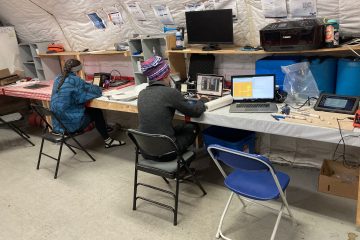
Two people in winter clothing work at laptops on long tables in a makeshift office with a white insulated wall, shelves, equipment, a printer, and various supplies scattered around.

Seminar – 18 September – Development and demonstration of a statistical ranking framework for ground temperature models, tailored towards permafrost environments.

Hannah Macdonell will be presenting Development and demonstration of a statistical ranking framework for ground temperature models, tailored towards permafrost environments.

Date: 18 September 2024
Time: 13:00-14:00 Eastern Time
Location: Zoom (details are posted in our Teams site).

Models used to simulate permafrost variables such as ground temperature are important tools for understanding the current state and future conditions of permafrost. However, few objective methods of establishing model accuracy exist for permafrost environments. Additionally, models often range in their performance given different conditions such as terrain type or seasonality. Hannah will be presenting her master’s research that looked at (1) identifying patterns in ground-temperature model performance under different testing conditions and (2) developing a quantitative measure of ground-temperature model performance in permafrost zones.

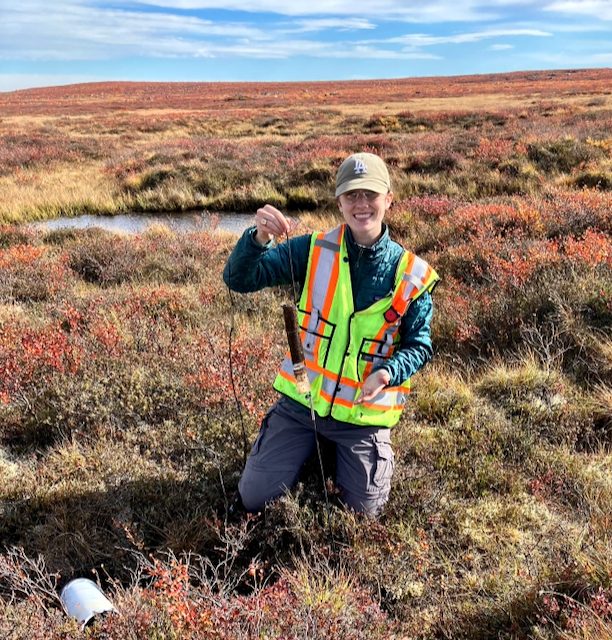
A person wearing a fluorescent safety vest and cap kneels in a field of low shrubs, smiling and holding a soil core sample. The landscape is open with reddish-brown vegetation under a blue sky.
By Tristan MacLean, ago
Aerial view of tundra landscape with irregular patches of green vegetation, dark ponds, and water-filled depressions, creating a mosaic pattern. The scene shows a mix of wetlands and grassy areas.

POSTPONED Seminar – 29 May – Performance of Drilling Waste Sumps, Western Arctic Canada.

Rae Landriau will be presenting Performance of Drilling Waste Sumps, Western Arctic Canada.

Date: 29 May 2024
Time: 13:00-14:00 Eastern Time
Location: Zoom (details are posted in our Teams site).

Petroleum resource exploration and development has occurred in the Northwest Territories since the 1920s. Freezing-point depressants, mainly potassium chloride, were added to drilling fluids to facilitate drilling into permafrost. Disposal of these fluids was typically in large man-made pits (sumps). Sumps were excavated in permafrost, with the intention that frozen ground would contain the fluids indefinitely. Climatic warming in northwest Canada has raised the temperature of near-surface permafrost, increasing the potential for failure of sumps in the region. Using electro-magnetic surveys, ground conductivity on and off sumps can be collected and analyzed to detect the presence of these fluids and determine if they have migrated.
A person with curly blonde hair and glasses takes a selfie outdoors, wearing a red top and backpack. Behind them is a river, greenery, and a clear blue sky with mountains in the distance.
By Tristan MacLean, ago
A small white and red single-engine propeller plane labeled Yukon Discovery is parked on a dirt airstrip, with mountains and trees in the background and a rustic building nearby.

Seminar – 22 May – Precise Change Detection with Airborne Interferometric Synthetic Aperture Radar (InSAR) & Optical Photogrammetry Data and its application to Active Permafrost Regions.

Usman Iqbal Ahmed will be presenting Precise Change Detection with Airborne Interferometric Synthetic Aperture Radar (InSAR) & Optical Photogrammetry Data and its application to Active Permafrost Regions.

Date: 22 May 2024
Time: 13:00-14:00 Eastern Time
Location: Zoom (details are posted in our Teams site).

Permafrost thaw can cause several problems; the ground becomes unstable and can cause damage to infrastructure such as roads, buildings, and pipelines. It can also cause erosion and changes in the landscape, which can have ecological and social impacts and disruption of indigenous ways of life. Monitoring these changes is a key factor in reducing the impact of such disasters as well as timely reaction/adaptation to such changes. I am exploring the option of developing a change detection method using Airborne Synthetic Aperture Radar (SAR) Interferometry and Optical Photogrammetry data for precise change detection. I will present the results of our controlled experiment with simulated permafrost related changes to showcase the capability of our method in active permafrost thaw environments.

A man wearing sunglasses, a red sweater, and a dark jacket stands outdoors in front of beige and white classical-style buildings. He has short black hair and is carrying a backpack.
By Tristan MacLean, ago
A person in a red jacket stands on a sandy beach near eroded cliffs, with grass on top and gentle waves washing ashore in the foreground. Debris is scattered along the beach.

Seminar – 1 May – Advancing Arctic coastal erosion measurement and monitoring through UAV-SfM and object-based image analysis.

Andrew Clark will be presenting Advancing Arctic coastal erosion measurement and monitoring through UAV-SfM and object-based image analysis.

Date: 1 May 2024
Time: 13:00-14:00 Eastern Time
Location: Zoom (details are posted in our Teams site).

Arctic coasts are vast and exhibit some of the highest rates of erosion in the World due to the presence of permafrost. Rates of erosion are expected to increase with warming air and water temperatures, reductions in Arctic sea ice extent and duration, sea level rise, and increased storm severity and frequency. This presentation will describe the use of emerging technologies (UAV-SfM and OBIA) to further our understanding of Arctic coastal processes, specifically, volumetric erosion, and broad scale delineation of multiple shoreline proxies for monitoring and quantification of erosion.

Andrew Clark
By Tristan MacLean, ago
Aerial view of a rural dirt road winding through a forested landscape with a large pond or wetland area on one side; two vehicles are driving along the road.

Seminar – 17 April – Climate change induced increases in maintenance costs for Yukon highways, 1994–2022.

Astrid Schetselaar will be presenting Climate change induced increases in maintenance costs for Yukon highways, 1994–2022.

Date: 17 April 2024
Time: 13:00-14:00 Eastern Time
Location: Zoom (details are posted in our Teams site).

Transportation networks in Canada’s North are becoming increasingly vulnerable to the impacts of climate change. Rising ground temperatures and permafrost thaw have been a cause of road damage as the bearing capacity of the ground is significantly reduced. Hydrological changes may further induce hazards, such as landslides, washouts, and icings (aufeis). Astrid’s presentation will outline a retrospective assessment of climate change-induced maintenance expenditures for highways in Yukon. Changes in costs are linked to climate, physiographic, conditions and underlying permafrost.

A woman in a blue jacket stands smiling in front of dramatic rocky mountain peaks shrouded in mist under a cloudy sky.
By Tristan MacLean, ago
A multicolored app icon with the letters S, I, K, and U beside the word Permafrost on a dark blue gradient background.

Seminar video – SIKU: the Indigenous Knowledge Social Network as a tool for Indigenous-led research and meaningful research engagement with Indigenous communities.

The NSERC PermafrostNet seminar video on SIKU is now available.

Sophie Crump presented her seminar on SIKU: the Indigenous Knowledge Social Network as a tool for Indigenous-led research and meaningful research engagement with Indigenous communities. Sophie presented examples of how SIKU is being used to document permafrost in the environment and opened up the discussion on using the platform for both knowledge sharing and monitoring of permafrost.

Two smartphones display the SIKU app. One screen shows a map with an animal sighting and a photo of people on snow with seals. The other shows a user’s posts, activity icons, and pending posts list.
By Tristan MacLean, ago
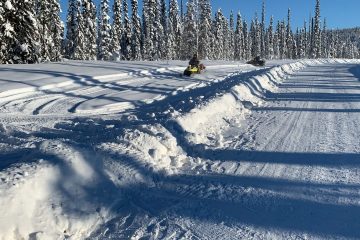
Two people riding snowmobiles on a snow-covered road lined with tall, snow-laden trees under a clear blue sky. Deep tracks and shadows are visible in the snow.

New seminar videos – Variation in the morphology of permafrost peatlands and Compacting snowbanks to lower ground temperatures.

Two new NSERC PermafrostNet seminar recordings are now available.

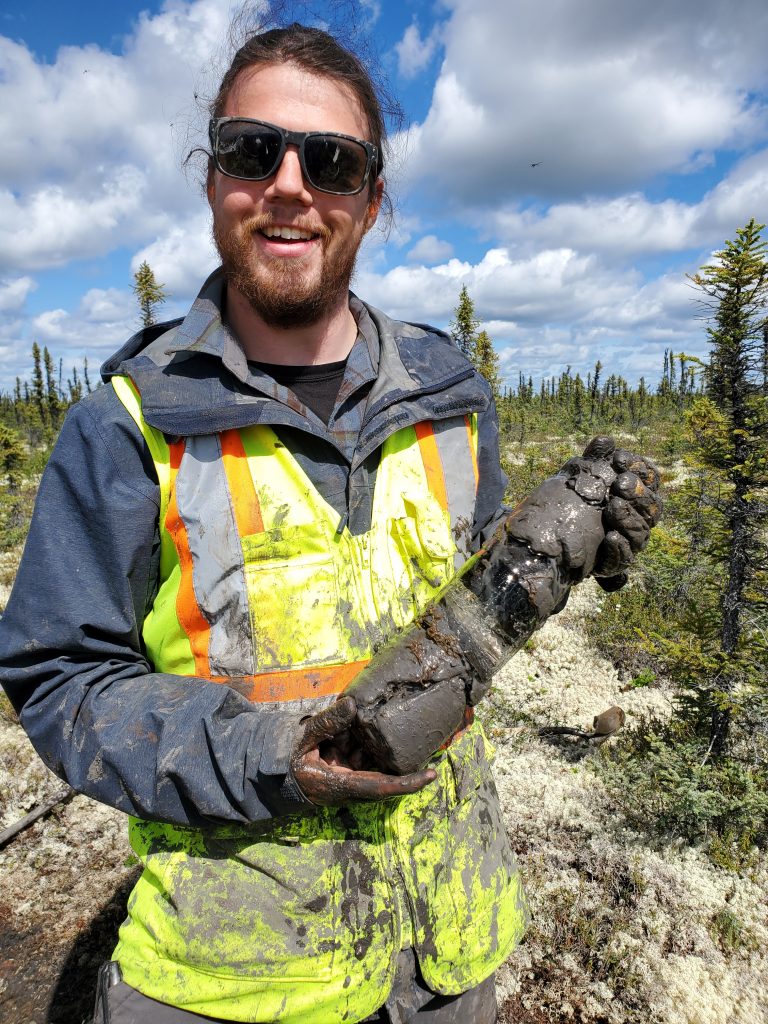
Alexandre Chiasson presented his seminar on Variation in the morphology of permafrost peatlands across the transition from continuous to discontinuous permafrost, central Mackenzie Valley.

A person wearing sunglasses and a reflective vest smiles while holding a muddy soil core sample outdoors, surrounded by trees under a partly cloudy sky.

Pat Jardine presented his seminar on Field experiments investigating snowpack compaction as a method of lowering ground temperatures.

A smiling person wearing glasses, a red baseball cap with a black and white logo, and a black jacket stands outdoors in front of a modern glass building and leafless tree.
By Tristan MacLean, ago