Characterizing carbon and water fluxes in the arctic boreal forest using plant hydraulics parameterization in the presence and absence of permafrost: a modelling approach – Muhammad Umair.
Flood Susceptibility Assessment of the Hudson Bay Railway – Adeleh Moqadam.
Beyond Frozen Ground: Seeing Ground Ice and Terrain Through a Different Lens – Niek Jesse Speetjens.
A Terrain based method for snow depth prediction applied in Svalbard, Norway – Lucas Fuertes.
Proglacial Retrogressive Thaw Slumping in the Scott Turnerbreen Forefield, Svalbard – Liam Carson.
Probabilistic Assessment of Thaw Settlement in Permafrost Terrain Under Climate Change – Khatereh Roghangar.
A model of temperature inversions to correct bias in reanalysis data – Victor Pozsgay.
How can we learn more about permafrost thaw in Canada from borehole temperature observations? – Olivia Meier-Legault.
Assessing Thaw Settlement Vulnerability of the Hudson Bay Railway in the Face of Climate Change – Zhina Rezvani.
Exploring Traditional Knowledge of Permafrost Change in the Gwich’in Settlement Area and Inuvialuit Settlement Region – Emma Street.
Ground Ice Detection With Spectral Induced Polarization – Hosein Fereydooni
Improving predictions of permafrost conditions by using data from climate models – Galina Jonat.
Post-Drainage Evolution of Wolverine Lake, Old Crow Flats, Yukon – Danielle Chiasson.
Permafrost Terrain Disturbance Susceptibility in the Nacho Nyäk Tagé (Stewart River) Watershed, Yukon – Frederic Brieger.
Characterizing the setting and dynamics of permafrost mass wasting – Joseph Young.
Measuring Active Layer Dynamics with InSAR – Allison Plourde.
A framework for evaluating thaw settlement in permafrost regions – Zakieh Mohammadi.
Evaluating the influence of mosses in the boreal forest with CLASSIC – Rose Lefebvre.
Performance of Drilling Waste Sumps, Western Arctic Canada – Rae Landriau
Development and demonstration of a statistical ranking framework for ground temperature models, tailored towards permafrost environments – Hannah Macdonell
Precise Change Detection with Airborne InSAR and Optical Photogrammetry data in permafrost regions – Usman Iqbal Ahmed
Ice-Wedge Volume, Distribution, and Development in the Barrens of the Hudson Bay Lowlands, Northern Manitoba – Tabatha Rahman
The effects of environmental controls on epigenetic ice-wedge cracking – Gabriel Karam
Advancing Arctic coastal erosion measurement and monitoring through UAV-SfM and object-based image analysis – Andrew Clark
Climate change induced increases in maintenance costs for Yukon highways, 1994–2022 – Astrid Schetselaar
Characterizing the response of Arctic streams and rivers to permafrost thaw – Erika Hille
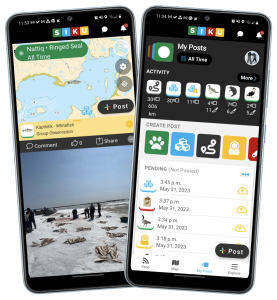
SIKU: the Indigenous Knowledge Social Network as a tool for Indigenous-led research and meaningful research engagement with Indigenous communities – Sophie Crump
Compacting Snowbanks to Lower Ground Temperatures and Preserve Permafrost – Patrick Jardine
Variation in the morphology of permafrost peatlands across the transition from continuous to discontinuous permafrost, central Mackenzie Valley – Alexandre Chiasson
Rock walls of western Canada: Evaluating the relationships between permafrost, topography and climate – Emilie Stewart Jones
Exploring the interactions between permafrost ground ice and soil organic carbon – Samuel Gagnon
Permafrost and mercury: revisiting a global hazard assessment at the regional scale in the Hudson Bay Lowlands – Adam Kirkwood
Application of the industrial computed tomography scanning in the characterization of permafrost and non-permafrost cores – Mahya Roustaei
Optimizing the Soil Carbon Module of CLASSIC – Charles Gauthier
Achievements & challenges creating the Canadian permafrost ER survey database – Teddi Herring
A temporal deep learning approach to bedfast and floating thermokarst lake ice mapping using SAR imagery – Maria Shaposhnikova
Permafrost data: challenges, opportunities and next practices – Nick Brown
5157