Yukon Territory and western Northwest Territories, including Mackenzie Mountains and adjacent Mackenzie River Valley, with locations of all weather stations.

Performance of climate projections for Yukon and adjacent Northwest Territories.

Performance of climate projections for Yukon and adjacent Northwest Territories.

La conception des infrastructures sur le pergélisol doit tenir compte des impacts du changement climatique sur la stabilité du sol. Alors que des lignes directrices comme la CSA PLUS 4011:19 fournissent un cadre, le choix de scénarios climatiques appropriés reste un défi.

L'étude par Astrid Schetselaar, Trevor Anderson et Chris Burn révèle que le réchauffement observé au Yukon et dans les Territoires du Nord-Ouest (1991 à 2020) correspond aux projections climatiques extrêmes réalisées en 2003 pour le projet gazier Mackenzie.

Points clés à retenir pour les développeurs :

  • Envisagez d’adopter des scénarios de changement climatique plus agressifs lors de la conception des fondations du pergélisol, car ces projections sont plus précises.
  • Le pergélisol proche de la surface dans les parties méridionales de la région pourrait devenir insoutenable. Des études approfondies du site pour détecter les sols stables au dégel sont cruciales.
  • La hausse des températures hivernales signifie que l'efficacité opérationnelle des thermosiphons, utilisés pour refroidir les fondations, pourrait être entravée. Sur les sites où la préservation du sol gelé est essentielle à l’intégrité des infrastructures, le nombre de thermosiphons requis peut devoir augmenter.

Schetselaar, A.B., Andersen, T.S., and Burn, C.R. 2023. Performance of climate projections for Yukon and adjacent Northwest Territories, 1991-2020. Arctic, 76(3). doi: 10.14430/arctic77263

Yukon Territory and western Northwest Territories, including Mackenzie Mountains and adjacent Mackenzie River Valley, with locations of all weather stations.
Territoire du Yukon et ouest des Territoires du Nord-Ouest, y compris les monts Mackenzie et la vallée adjacente du fleuve Mackenzie, avec l'emplacement de toutes les stations météorologiques.

A multicolored app icon with the letters S, I, K, and U beside the word Permafrost on a dark blue gradient background.

Seminar video – SIKU: the Indigenous Knowledge Social Network as a tool for Indigenous-led research and meaningful research engagement with Indigenous communities.

The NSERC PermafrostNet seminar video on SIKU is now available.

Sophie Crump presented her seminar on SIKU: the Indigenous Knowledge Social Network as a tool for Indigenous-led research and meaningful research engagement with Indigenous communities. Sophie presented examples of how SIKU is being used to document permafrost in the environment and opened up the discussion on using the platform for both knowledge sharing and monitoring of permafrost.

Two smartphones display the SIKU app. One screen shows a map with an animal sighting and a photo of people on snow with seals. The other shows a user’s posts, activity icons, and pending posts list.

Northern Research Leadership and Equity: The Expert Panel on the Future of Arctic and Northern Research in Canada

NSERC PermafrostNet Contributes to Landmark Report on the Future of Arctic and Northern Research in Canada.

NSERC PermafrostNet is proud to have supported and contributed to a groundbreaking new report from the Council of Canadian Academies (CCA) that charts a transformational path forward for Arctic and Northern research in Canada.

Released this month, Northern Research Leadership and Equity: The Expert Panel on the Future of Arctic and Northern Research in Canada addresses longstanding systemic challenges in Arctic research and provides guidance on creating an inclusive, collaborative, effective, and world-class Arctic and Northern research system.

A Call for Transformational Change

For too long, Arctic and Northern research has been dominated by Southern researchers, institutions, and priorities, often ignoring Indigenous Peoples, their rights, cultures, and knowledge systems. The expert panel determined that true transformation requires centering Indigenous leadership, voices, and engagement at all stages of the research process.

PermafrostNet’s Role and Contributions

The CCA assessment was sponsored by a consortium of Arctic and Northern research and science organizations from across Canada, led by ArcticNet, with financial support and input from NSERC PermafrostNet and other leading northern research networks.

PermafrostNet members played critical roles in developing this important report:

  • Dr. Stephan Gruber, NSERC PermafrostNet Scientific Director and Professor at Carleton University, provided expert input to the panel, drawing on his extensive experience in Arctic research.
  • Dr. Shawn Marshall, member of NSERC PermafrostNet’s Strategy Committee, glaciologist, and Departmental Science Advisor at Environment and Climate Change Canada, served as a peer reviewer for the report.
  • Dr. Nicole Wilson, member of NSERC PermafrostNet’s Scientific Committee and Canada Research Chair in Arctic Environmental Change and Governance at the University of Manitoba, also served as a peer reviewer.
Comparison of mountain areas with permafrost in western Canada (coloured) and European areas (grey) for mean annual air temperature and total annual precipitation at a resolution of 30 km x 30 km.

Transfert des connaissances sur la cryosphère entre les montagnes au niveau mondial : Une étude de cas des montagnes de l’Ouest canadien, des Alpes européennes et des Scandes

Transfert des connaissances sur la cryosphère entre les montagnes au niveau mondial : Une étude de cas des montagnes de l’Ouest canadien, des Alpes européennes et des Scandes

La plupart des recherches sur le pergélisol de montagne se sont concentrées sur la petite zone des Alpes européennes. Cela nous amène à la question suivante : pouvez-vous transférer les connaissances sur la cryosphère des Scandes et des Alpes au Canada?

Emilie Stewart-Jonesa développé une méthode permettant de comparer les climats régionaux à une échelle grossière afin de mettre en évidence les similarités et les différences. Son articleTransfert des connaissances sur la cryosphère entre les montagnes au niveau mondial : Une étude de cas des montagnes de l’Ouest canadien, des Alpes européennes et des Scandespublié dans le Journal of Alpine Research en novembre peut désormais répondre à la question de savoir si nous pouvons transférer nos connaissances sur le pergélisol d'une région à une autre.

Comparison of mountain areas with permafrost in western Canada (coloured) and European areas (grey) for mean annual air temperature and total annual precipitation at a resolution of 30 km x 30 km.
Comparaison des zones montagneuses avec pergélisol dans l'ouest du Canada (en couleur) et dans les régions européennes (en gris) pour la température annuelle moyenne de l'air et les précipitations annuelles totales à une résolution de 30 km x 30 km.

Coverage of the ArcticDEM in the Arctic with permafrost extent.

Identifying active retrogressive thaw slumps from ArcticDEM

 Identifying active retrogressive thaw slumps from ArcticDEM

L’ampleur du dégel du pergélisol dans la région panArctique reste inconnue, mais la télédétection, l’apprentissage profond et le « crowdsourcing » aident à cartographier la dégradation du pergélisol dans le paysage.

L'étude récente de Huang et al fournit des données et sert à dresser un inventaire mondial et à mieux comprendre le dégel du pergélisol dans la région panarctique grâce à la télédétection à très haute résolution. Cette approche pourrait conduire à un inventaire mondial des effondrements régressifs liés au dégel.

Lingcao Huang, Michael J. Willis, Guiye Li, Trevor C. Lantz, Kevin Schaefer, Elizabeth Wig, Guofeng Cao, Kristy F. Tiampo, Identifying active retrogressive thaw slumps from ArcticDEM, ISPRS Journal of Photogrammetry and Remote Sensing, Volume 205, 2023, Pages 301-316, ISSN 0924-2716.

Coverage of the ArcticDEM in the Arctic with permafrost extent.
Couverture de l'ArcticDEM dans l'Arctique avec étendue du pergélisol.

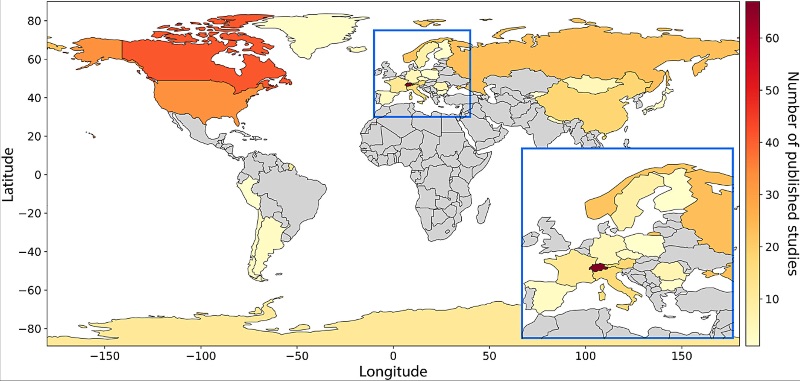
Global map summarizing locations of field sites where electrical resistivity tomography (ERT) has been used to study permafrost (2000–22) based on the literature search.

Best practices for using electrical resistivity tomography to investigate permafrost.

Best practices for using electrical resistivity tomography to investigate permafrost

Une étude récente de Teddi Herring suggère des moyens d'améliorer la façon dont la tomographie par résistivité électrique (Electrical Resistivity Tomography ou ERT) est utilisée pour le pergélisol et met en évidence les progrès récents dans cette approche. L'ERT est une technique extrêmement utile pour étudier le pergélisol, car elle nous permet de connaître la profondeur de la couche de pergélisol et d'identifier les zones contenant de la glace.

Le nombre de publications d'études utilisant l'ERT pour analyser le pergélisol a été multiplié par 10 au cours des 20 dernières années, et bien que des défis demeurent et qu'il n'existe pas encore de « meilleure façon » unique de le faire, l'étude formule des recommandations pour mener des études ERT afin de maximiser l’utilité des données existantes et futures.

Herring T,  Lewkowicz AG,  Hauck C, et al.  Best practices for using electrical resistivity tomography to investigate permafrostPermafrost and Periglac Process.  2023; 34(4): 494-512. doi:10.1002/ppp.2207

Global map summarizing locations of field sites where electrical resistivity tomography (ERT) has been used to study permafrost (2000–22) based on the literature search.
Carte mondiale résumant les emplacements des sites de terrain où la tomographie par résistivité électrique (ERT) a été utilisée pour étudier le pergélisol (2000 à 2022) sur la base de la recherche documentaire.

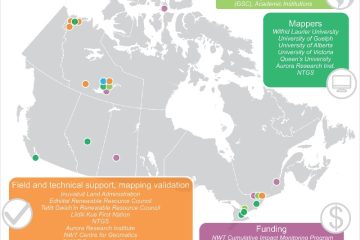
Project organization, roles and institutional involvement by location.

The Northwest Territories Thermokarst Mapping Collective: a northern-driven mapping collaborative toward understanding the effects of permafrost thaw

The Northwest Territories Thermokarst Mapping Collective: a northern-driven mapping collaborative toward understanding the effects of permafrost thaw.

Un article du Thermokarst Mapping Collective (TMC), une collaboration de recherche visant à inventorier systématiquement les indicateurs de sensibilité au dégel du pergélisol par cartographie et évaluations aériennes dans les Territoires du Nord-Ouest (NT), au Canada, a documenté le premier inventaire complet des terrains thermokarst et d’indicateurs sensibles au dégel pour une région de 2 millions de kilomètres2 carrés du nord-ouest du Canada.

Kokelj, S.V. et alThe Northwest Territories Thermokarst Mapping Collective: a northern-driven mapping collaborative toward understanding the effects of permafrost thawArctic Science. E First. DOI: 10.1139/as-2023-0009.

Project organization, roles and institutional involvement by location.
Organisation du projet, rôles et implication institutionnelle par localisation.

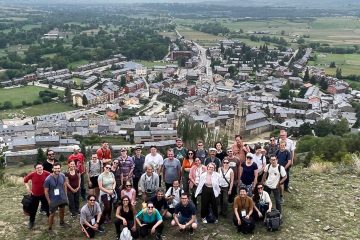
A large group of people poses on a grassy hilltop overlooking a town with many buildings, roads, and green fields, set against a backdrop of mountains and cloudy skies.

6th European Conference on Permafrost (EUCOP 2023)

Blog post by Samuel Gagnon and Pia Blake.

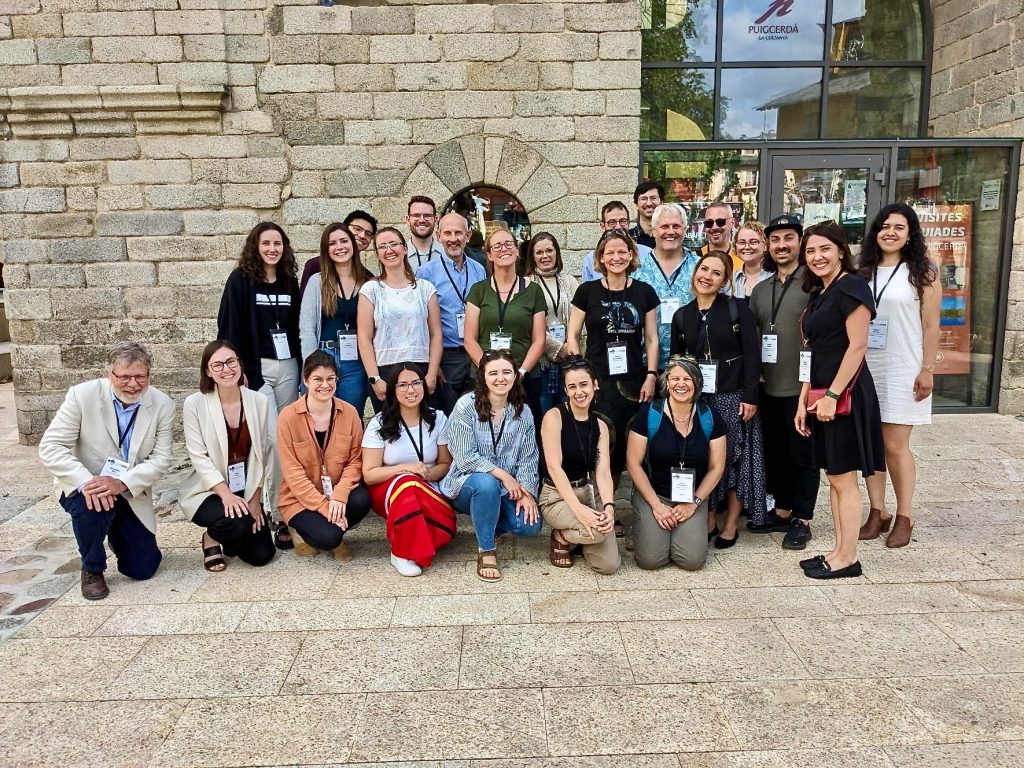
Members of NSERC PermafrostNet gathered in Puigcerdà, Spain, last week for the 6th European Conference on Permafrost (EUCOP 2023). The conference brought together nearly 500 permafrost scientists from all over the world and covered a wide range of permafrost topics from research to engineering and outreach. It was a real treat to have an entire week dedicated to permafrost, something that had not happened since the last EUCOP in 2018. The relatively small number of attendants combined with the proximity that a smaller town offers were the perfect ingredients to renew and create new partnerships, exchange ideas in a casual atmosphere, and create a sense of community.

During the week, scientists attended lectures, participated in topical sessions, and discussed at ‘beer, poster, and cheese’ sessions (yes, that’s the official order from the program!). The quality and variety of presentations were outstanding, and Canadian researchers once again showed the relevance of their work and their know-how to their international colleagues. Many PermafrostNet members distinguished themselves by giving exceptional talks to the assembled participants, including Tabatha Rahman (ULaval), Hannah Macdonell (UCarleton), Adam Kirkwood (ULaval), Mahya Roustaei (UAlberta), Emma Street (UVic), and Toni Lewkowicz (UOttawa), while many others gave poster presentations.

Rounding out the week was a series of day-long field excursions on a range of topics. Participants could learn about the anthropogenic history of the region, the geological history, or explore the mountain peaks surrounding Puigcerdà in the eastern Pyrenees (Cerdanya, Núria, Andorra).

The week flew by and was inspiring and motivating. Many thanks to the organisers who worked tirelessly and pulled off an amazing conference!  We look forward to welcoming all to the International Conference on Permafrost (ICOP2024) next year in Whitehorse.

In the meantime, please submit an abstract or join us at the permafrost session – Exploring the Roles of Ground Ice on Permafrost Dynamics at AGU23 on 11-15 December in San Francisco.

A group of around 25 adults pose and smile together outside a stone building with arched windows. Most wear conference name badges and casual or business attire. The atmosphere is friendly and relaxed.
Two people riding snowmobiles on a snow-covered road lined with tall, snow-laden trees under a clear blue sky. Deep tracks and shadows are visible in the snow.

New seminar videos – Variation in the morphology of permafrost peatlands and Compacting snowbanks to lower ground temperatures.

Two new NSERC PermafrostNet seminar recordings are now available.

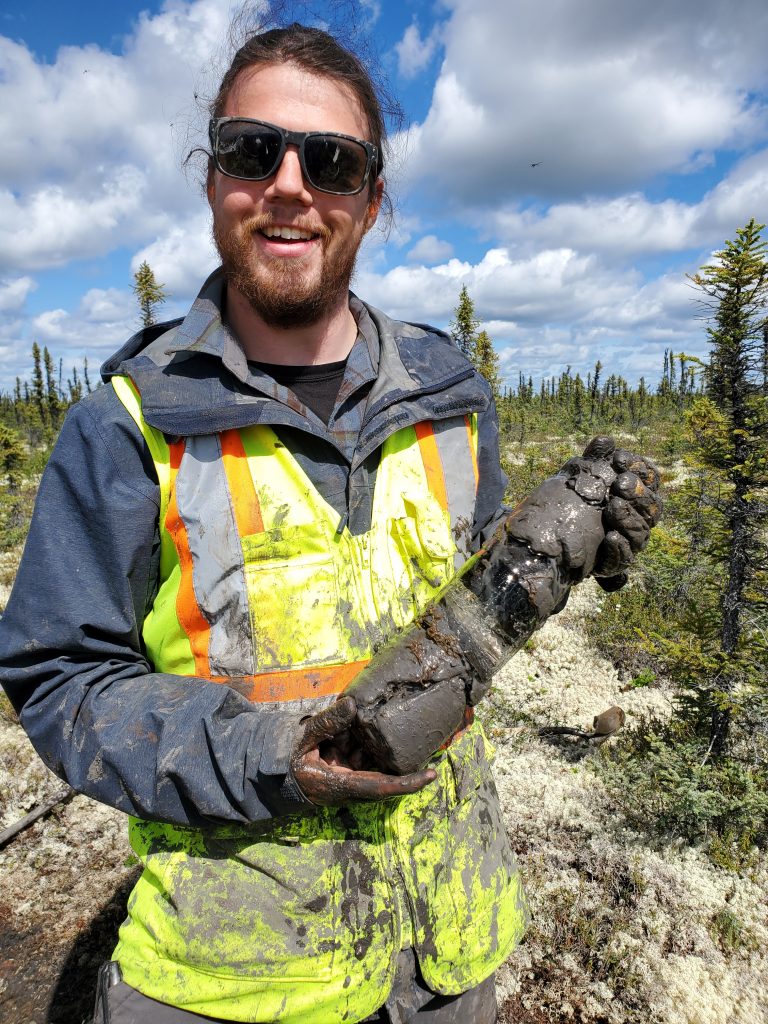
Alexandre Chiasson presented his seminar on Variation in the morphology of permafrost peatlands across the transition from continuous to discontinuous permafrost, central Mackenzie Valley.

A person wearing sunglasses and a reflective vest smiles while holding a muddy soil core sample outdoors, surrounded by trees under a partly cloudy sky.

Pat Jardine presented his seminar on Field experiments investigating snowpack compaction as a method of lowering ground temperatures.

A smiling person wearing glasses, a red baseball cap with a black and white logo, and a black jacket stands outdoors in front of a modern glass building and leafless tree.