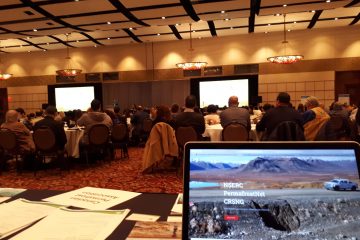
A conference room filled with people seated at round tables, facing a stage with large screens. In the foreground, a laptop displays a website about NSERC PermafrostNet. Papers are spread on the table next to the laptop.

Land Claims Agreement Coalition Conference 2020

“Until this conference I wasn’t aware of the extent of Modern Treaties Territories, but I know that permafrost is distributed across much of northern Canada. The conference made me realize that these Territories almost completely overlap the permafrost zones in Canada. Several northern communities are severely impacted by climate change and thawing permafrost, but it really hits home that most of the future permafrost changes will occur within Modern Treaties Territories.”

Peter Morse, CPA Secretary and NSERC PermafrostNet collaborator
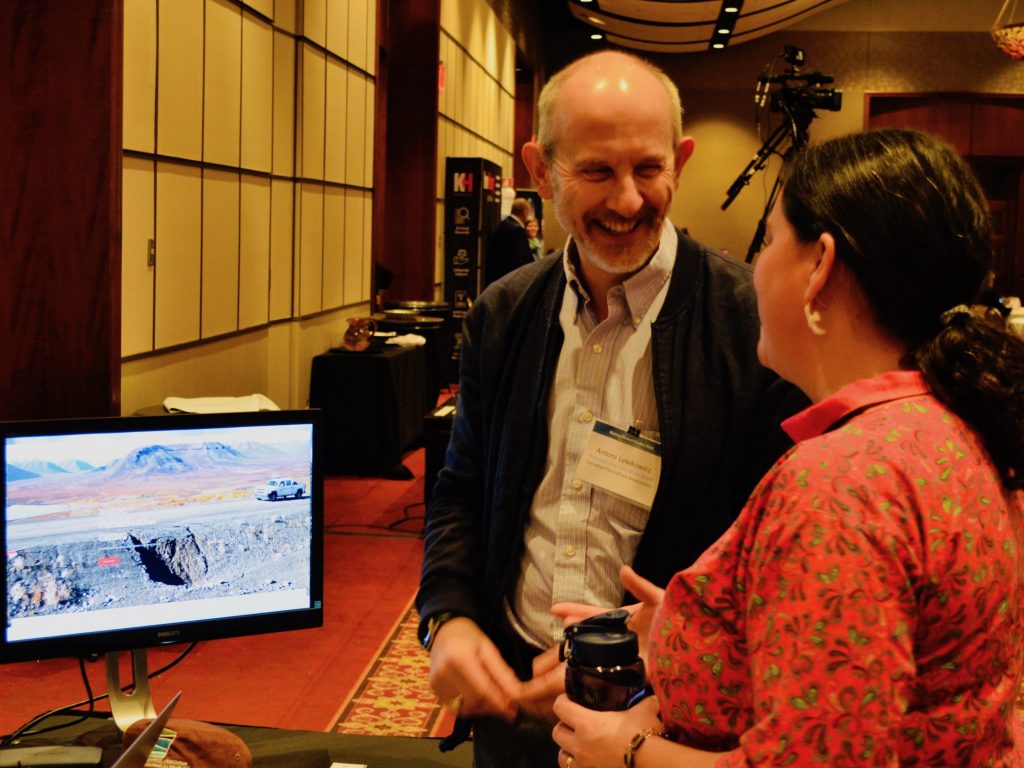
Two people stand by a computer monitor displaying a desert landscape at an indoor event. The man is smiling and wearing a name tag, while the woman holds a cup and faces him, engaging in conversation.

On 11 and 12 February 2020, the Land Claims Agreement Coalition held their 8th National Conference, Making Modern Treaties Work: Building Today for a Better Tomorrow in Gatineau, QC.
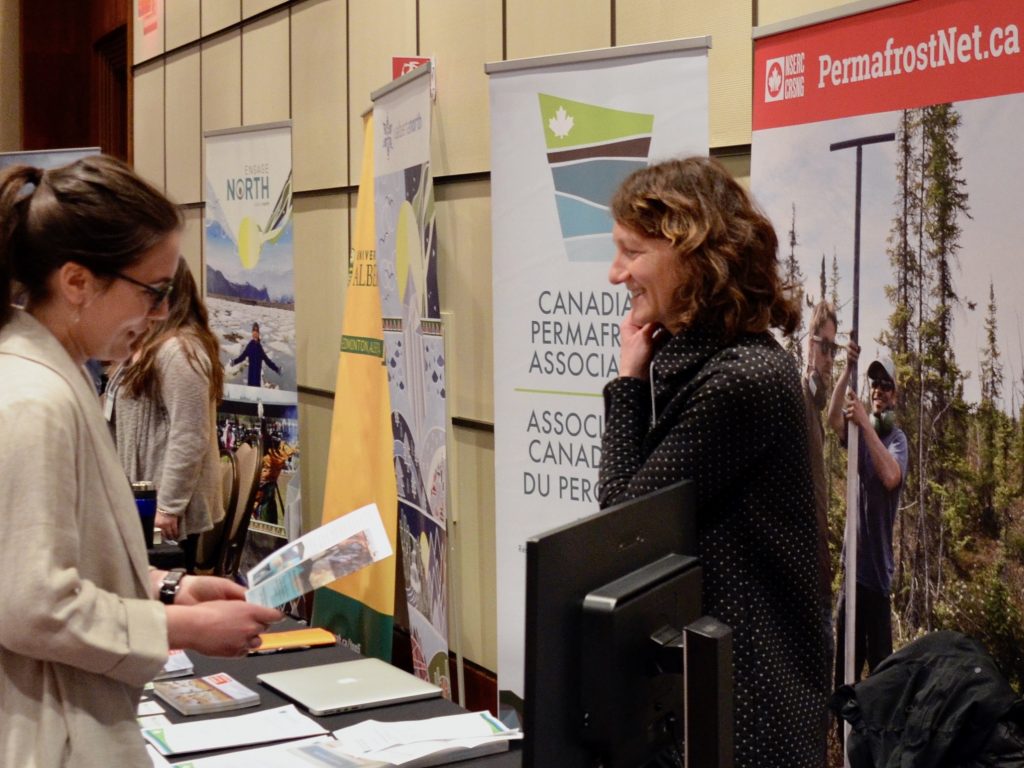
Two women speak at a booth with brochures and banners about permafrost studies, including one for the Canadian Permafrost Association. A large photo banner behind them shows research in a forested area.

NSERC PermafrostNet and the Canadian Permafrost Association came together to share a booth at the conference. The event provided a great opportunity to introduce our two organizations, explain what we do and hear about the climate-change related challenges faced by Indigenous communities.
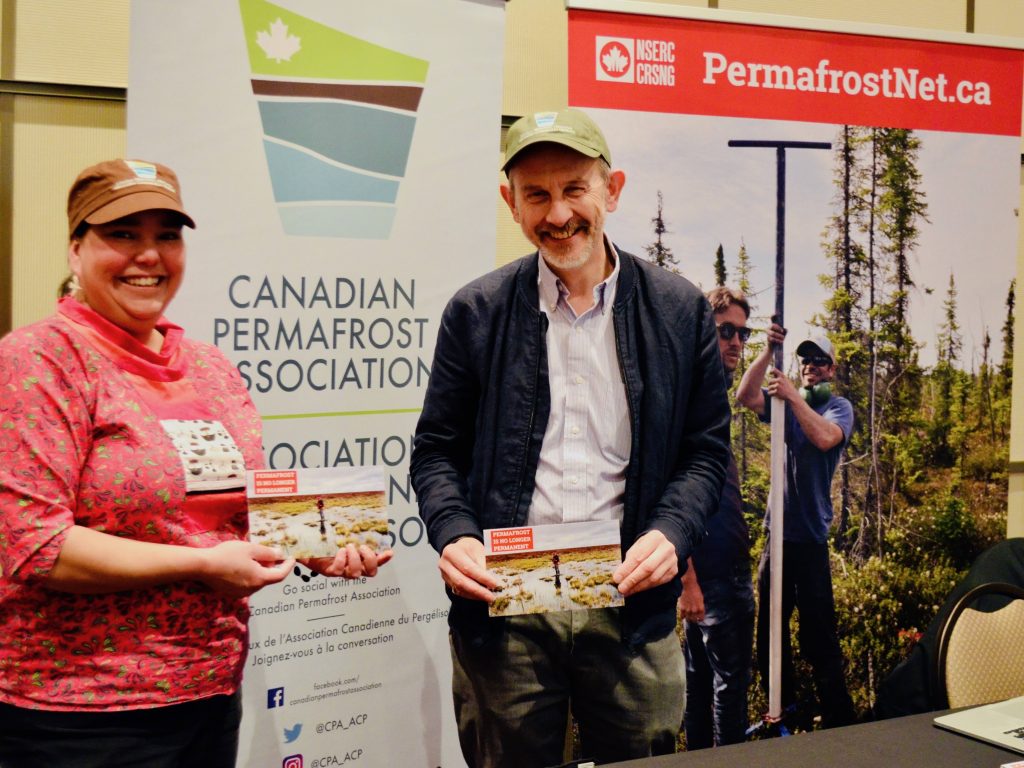
Two people smile at a booth with Canadian Permafrost Association and PermafrostNet.ca banners, holding brochures. Another banner shows two people in the field taking permafrost measurements.

The conference featured high-profile Canadian and international speakers, First Nation and Inuit leaders and youth, leading to meaningful discussions of timely legal, cultural and governance issues. The sessions focused on academic and technical training and improving intergovernmental relationships. Esteemed and inspiring speakers, included: Dana Tizya-Tramm, Chief, Vuntut Gwitchin First Nation, Daniel Watson, Deputy Minister of CIRNAC, P.J. Akeeagok, President of the Qikiqtani Inuit Association and Gregor Gilbert, Director, Department of Environment, Wildlife, and Research at Makivik Corporation.

Photos: Tristan MacLean

A snowy, frozen landscape with mountains in the background, illuminated by green aurora borealis lights in the night sky, reflecting on icy water in the foreground.

Third Canadian Polar Data Workshop

The workshop was the ideal venue to introduce PermafrostNet to the polar data management community and to learn from other communities of practice to ensure that the network will help permafrost data fit into the broader ecosystem of interoperability.”

Nick Brown
A reserved table set for a meal at a bright, windowed venue with a sign reading Third Canadian Polar Data Workshop. Snowy mountains and people are visible through large windows in the background.

Le sous-thème Third Canadian Polar Data Workshop was held 18-21 February 2020 in Banff, Alberta. The event is organized by the Canadian Consortium for Arctic Data Interoperability (CCADI), who aim to advance collaboration, through development of an integrated Canadian arctic data management system and Arctic Research Data Infrastructure (ARDI). The purpose of the third Canadian Polar Data Workshop is to gather people involved in polar data management from across Canada to share ideas and identify key priorities and commitments for coordinating the work of the polar data community and, ultimately, advancing our work.

A group of people are seated at round tables in a conference room, listening to a presenter speaking next to a projected presentation slide. Laptops, notebooks, and coffee cups are on the tables.

The workshop provided an opportunity for members of the Permafrost Network to discuss issues of data sharing architectures and data governance with research communities who are facing similar challenges. In attendance from NSERC PermafrostNet were scientific director Stephan Gruber, scientific committee member Peter Pulsifer, network data scientist Nick Brown as well as two members from the broader PermafrostNet community: Ashley Rudy (Northwest Territories Geological Survey) and Etienne Godin (Laval University).

A scientific research poster about NSERC PermafrostNet is displayed on a wall next to a framed abstract black and white artwork resembling a large nail or stake. Both hang above a light-colored wooden ledge.

Held at the Banff Centre, the workshop began with presentations from some of the attending organizations including PolarView, CCADI and Inuit Tapiriit Kanatami. There were presentations by network member Peter Pulsifer and a poster by the PermafrostNet data scientist Nick Brown on advancing interoperable and open permafrost data on day two. The agenda then turned to a more interactive format identifying the needs of the community for improved formal vocabularies and semantics, and visioning the formation of a committee to help coordinate polar data management. The event concluded with a hackathon focused on implementing code to make datasets more discoverable online. A relatively strong turnout by the permafrost community made for great conversations between formal sessions, and will help PermafrostNet make data interoperable with other initiatives.

Photos: Nick Brown

Third Canadian Polar Data Workshop Poster
Raven interview with Nick Brown

Unfrozen: How digging and data can help mitigate permafrost thaw

“Highways buckle and heave, houses sink, and pipelines and other linear infrastructure are particularly susceptible.”

Nick Brown, NSERC PermfrostNet Data Scientist
A climber wearing a helmet and safety gear ascends a steep, rocky mountain face using ropes, with snow and ice visible in the background.

Nick Brown was recently interviewed for the first edition of the new Carleton University magazine – Raven.

“PermafrostNet’s data scientist, Nick Brown, who met Gruber while running a fly-in geological services field camp on the tundra east of Yellowknife and later did his master’s degree with Gruber, explains how the new network will address one of climate change’s biggest challenges.”

Raven interview with Nick Brown

You can read the full interview on page 44 of the new Carleton University magazine Raven.

Raven magazine is published by Carleton University’s Department of University Communications, with support from the Office of the President and the Office of the Provost. Raven is a showcase for the important and impactful work of Carleton faculty, students, staff, alumni and the university’s community partners.

Photo: Stephan Gruber

Northern Lights 2020

Northern Lights 2020

Members of NSERC PermafrostNet were honoured to attend the 2020 Northern Lights Showcase at the Shaw Centre in Ottawa between 5 – 8 February. The event is Canada’s number 1 Eastern Arctic and Northern conference, featuring presentations, an exhibitor showcase, workshops and a variety of networking opportunities. The first Northern Lights event was in 2008 and now happens every two years, focusing on the socio-economic and cultural development of Nunavut, Nunavik and Labrador / Nunatsiavut.

Northern Lights 2020

“The quality and engagement of the speakers and panelists at the workshops I attended were very high.  The presenters were all sincere, approachable and knowledgeable, and I learned a great deal about the North and Northern engagement”

Shirley McKey, NSERC PermafrostNet Director of Operations
Shirley McKey at Northern Lights 2020

PermafrostNet had a booth on the show floor, where we were able to speak to delegates and members of the public; explaining who we are and what we do. We had a lot of interest from visitors to the show, wanting to know all about permafrost and sharing their experiences of living with permafrost in a changing world. The showcase was a fantastic opportunity to engage and hear from Canadian businesses, community leaders and indigenous government about permafrost and life in the North. The event was attended by Scientific Director (Stephan Gruber), Director of Operations (Shirley McKey) and Knowledge Mobilization and Communications Coordinator (Tristan MacLean).

The conference sessions covered a wide range of areas impacted by permafrost change, such as infrastructure, housing, construction, transport and communication as well as areas where collaboration will help the network share knowledge and serve northern communities such as education and communications. Of particular interest to the network were the sessions ‘Northern Infrastructure: Building for the Future‘ and ‘Arctic Research & Education: Supporting Sustainable Northern Communities‘ as well as the opportunity to make connections and build relationships with many residents and organizations based in the North whose lives and livelihoods are being directly impacted by permafrost thaw.

Shirley McKey engaging delegates at Northern Lights 2020

Photos: Tristan MacLean

Theme 1 workshop

Theme 1 and Database Development Workshop

“It was very convenient to be able to connect to the workshop remotely so that I could get an update on other people’s work and so I could give an update on my research as well. I like how the network ensures everybody can attend important meetings while also helping to lower our carbon footprint.”

Ariane Castagner
A man gestures while explaining geological diagrams displayed on a large screen, which show cross-sections of soil layers and labeled data, in a classroom or meeting room setting.

In February 2020 Theme 1 organized a two-day database development meeting in Ottawa that brought together investigators, graduate students, government collaborators and the network data scientist. This was the network’s first hybrid event, with some participants joining virtually using ZOOM, a video conferencing platform. 

Theme 1 workshop

The event began on Thursday 6 February with a discussion about the existing ground ice maps for Canada.  Brendan O’Neill and Steve Wolfe presented the most recent GSC ground ice map (O’Neill et al. 2020), and the group discussed the possible areas for improvement and future. In the afternoon, students Joe Young, Alejandro Alvarez and Ariane Castagner presented on their research.

Four men are seated at a conference table having a discussion, while another man stands by the wall near a screen displaying the SARlab logo and presentation. Laptops, papers, and coffee cups are on the table.

On Friday, Steve Kokelj introduced the NWT Thermokarst Mapping Initiative and discussed possibilities for evaluating the Ground Ice Distribution and thermokarst potential. Next, the group reviewed regional datasets that could be used to test or improve ground ice mapping; Peter Morse, Ariane Castagner, Ashley Rudy, Panya Lipovsky, Pascale Roy Léveillée, Daniel Fortier and Toni Lewkowicz each presented datasets from their study sites or area of expertise. These datasets ranged in geography from the Yukon to the Hudson Bay Lowlands to the polar deserts of the high arctic.

This was followed by a discussion of some of the key questions for the PermafrostNet Ground Ice Potential map: whether test sites should be used for evaluation (and how such and evaluation might be done!) and how the maps might move past rule-based strategies to include remotely sensed or hybrid models.

Finally, Nick Brown presented on the existing database structures that could be used for compiling diverse permafrost data for the network, and initiated discussion about how to improve the database to meet the needs of the network. This also included a discussion of how ground ice mapping efforts could benefit from the PermafrostNet partnership with CCADI. 

Photos: Nick Brown and Emma Stockton

Student employment program – Freezing and thawing processes using passive or/and active inter-seasonal heat/cold redistribution systems to stabilize permafrost thawing or thaw permafrost.

Posted: January 2020
Anticipated start:  January 2020.
Supervisor: Igor Egorov, Research Officer / Agent de recherche associé, Civil Engineering Infrastructure / Infrastructures de génie civil, Construction Research Centre / Centre de recherche en construction, National Research Council Canada / Conseil national de recherches Canada.

Project description: Freezing and thawing processes using passive or/and active inter-seasonal heat/cold redistribution systems to stabilize permafrost thawing or thaw permafrost.

Job description: Literature review, data analyses. mathematical modelling and participating in design of effective inter-seasonal heat/cold redistribution systems based on the collected field data. Knowledge of mathematics, thermodynamics, permafrost sciences, physics of freezing and thawing, heat and mass transfer will be an asset.

Student employment program – further details.

Research Abstract 

Project intends to model and design heat transfer systems for the new technology called inter-seasonal heat/cold transfer, to stabilize permafrost and increase resilience of buildings and infrastructure against permafrost degradation and weather extremes or thaw permafrost before construction. Mathematical modelling of inter-seasonal heat/cold transfer based on collected field data combined with historical data will provide direct and reliable methodology for capturing surplus cold in the winter and storing it in the ground using phase change material or soils. This heat (cold) could be released in summer to reduce costs repairs and maintenance of buildings or infrastructure. Another application of inter-seasonal heat/cold technology is to prevent permafrost degradation and stabilize thawing ice –rich permafrost.

Salary: $446 to $994 per week (37.5 hrs). Masters level – $754 to $892 per week depending on the number of completed semesters.

APPLICATION: Applications for this permafrost project should be submitted to Igor Egorov (igor.egorov@nrc-cnrc.gc.ca). Please note this is part of the NRC student employment program. If you are applying for any other student employment opportunity with NRC please send applications to info@nrc-cnrc.gc.ca. NRC hiring managers search the database for qualified candidates throughout the year. In order to be considered for the program please include the following in your application, please note that you will need to attach the required documents as per the list below when submitting your application. Failure to do so will result in your application being excluded from searches.

  • Resume
  • Most recent transcript: 
    • University/high school (grade 12 or equivalent)
    • An electronic copy is sufficient, it does not have to be an official version
    • To attach your transcript click the “add a document” in the Second language evaluation results field
    • Additionally, in order to maximize your chances of being considered for opportunities, ensure to include your preferred location(s) in the Preferred Work Location(s) section of the application

A group of about 35 people, wearing conference badges, pose together in a hotel meeting room after a permafrost seminar. Some are standing, others are seated or kneeling in front, with carpeted floors and a large window in the background.

NSERC PermafrostNet Inaugural Annual General meeting

The NSERC PermafrostNet Inaugural Annual General meeting was held in Ottawa, ON on the 6th and 7th of November 2019. It was a highly vibrant and successful event, featuring over 50 members of the network from across Canada, both in-person and attending remotely. There were participants from as far away as Sachs Harbour, Northwest Territories; Whitehorse, Yukon; and Churchill, Manitoba; taking part in what we hope will prove to be a historic meeting of permafrost experts. The two-day event featured a day of presentations and discussions, including break-out sessions for each of the five research themes, and meetings of the Board of Directors, Scientific Committee and Knowledge Mobilization and Communications Committee. Most auspiciously, the Annual General Meeting aligned with International Inuit day.  International Inuit Day has been held annually since 2006 on November 7th, to coincide with the birth date of the late Eben Hopson, founder of the Inuit Circumpolar Council (ICC), a major international non-government organization representing approximately 180,000 Inuit of Alaska, Canada, Greenland, and Chukotka (Russia).

Photos: Ariane Castagner

PhD in remote sensing of permafrost landscape change

Posted: July 14, 2020
Anticipated start:  January 2021
Supervisory team: Dr. Trevor Lantz and Dr. Robert Fraser

The Arctic Landscape Ecology Lab at the University of Victoria is seeking a PhD student to lead a research project: 1) mapping permafrost landscape change and 2) assessing the determinants of terrain sensitivity.

In many permafrost regions, the frequency of thaw-related disturbances is increasing so rapidly that maintaining accurate inventories presents a significant challenge. The first objective of this project is to develop semi-automated procedures to map permafrost terrain disturbances using satellite imagery (e.g., Landsat, WorldView, Sentinel). The second objective is to determine the biophysical controls of terrain sensitivity by analyzing the disturbance inventories generated through mapping. By identifying sensitive areas and increasing our capacity to monitor change, this project will significantly inform decision making in northern communities and regions affected by permafrost thaw. 

Interested applicants should have an MSc in geography, environmental science, earth science, or related field, and previous experience with remote sensing, GIS and statistics. Applicants must be self-motivated, have strong communication skills, experience managing multiple tasks, and be willing to travel to the Canadian Arctic for fieldwork. Previous experience in permafrost environments is an asset, but is not vital.

An annual stipend of $21,000 (plus benefits) is guaranteed for four years and additional support for field and conference travel is available for the duration of the project.

This research project is part of NSERC PermafrostNet, a multi-sectorial research network of twelve Canadian universities and more than 40 partner organisations. As a member of the network, the successful applicant will have opportunities to engage with government (provincial, federal, indigenous), industry, and international partners, as well as graduate students and researchers from across Canada.  

The University of Victoria and NSERC PermafrostNet are strongly committed to fostering diversity as a source of excellence, cultural enrichment, and social strength. We welcome those who would contribute to further diversification including, but not limited to, women; visible minorities; First Nations, Inuit and Métis peoples; persons with disabilities; and persons of any sexual orientation or gender identity and expressions.

To apply, please send a cover letter describing your qualifications and interest in this project, a complete CV, and unofficial transcripts to Dr. Trevor Lantz (tlantz@uvic.ca). Questions should be directed to Dr. Trevor Lantz (tlantz@uvic.ca) or Dr. Robert Fraser (robert.fraser@canada.ca).