Aerial view of tundra landscape with irregular patches of green vegetation, dark ponds, and water-filled depressions, creating a mosaic pattern. The scene shows a mix of wetlands and grassy areas.

Seminar – 16 October – Performance of Drilling Waste Sumps, Western Arctic Canada.

Rae Landriau will be presenting Performance of Drilling Waste Sumps, Western Arctic Canada.

Date: 16 October 2024
Time: 13:00-14:00 Eastern Time
Location: Zoom (details are posted in our Teams site).

Petroleum resource exploration and development has occurred in the Northwest Territories since the 1920s. Freezing-point depressants, mainly potassium chloride, were added to drilling fluids to facilitate drilling into permafrost. Disposal of these fluids was typically in large man-made pits (sumps). Sumps were excavated in permafrost, with the intention that frozen ground would contain the fluids indefinitely. Climatic warming in northwest Canada has raised the temperature of near-surface permafrost, increasing the potential for failure of sumps in the region. Using electro-magnetic surveys, ground conductivity on and off sumps can be collected and analyzed to detect the presence of these fluids and determine if they have migrated.

By Tristan MacLean, ago
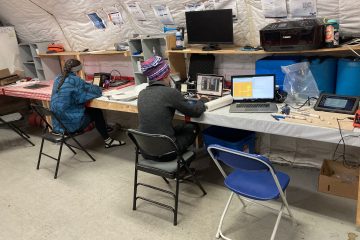
Two people in winter clothing work at laptops on long tables in a makeshift office with a white insulated wall, shelves, equipment, a printer, and various supplies scattered around.

Seminar – 18 September – Development and demonstration of a statistical ranking framework for ground temperature models, tailored towards permafrost environments.

Hannah Macdonell will be presenting Development and demonstration of a statistical ranking framework for ground temperature models, tailored towards permafrost environments.

Date: 18 September 2024
Time: 13:00-14:00 Eastern Time
Location: Zoom (details are posted in our Teams site).

Models used to simulate permafrost variables such as ground temperature are important tools for understanding the current state and future conditions of permafrost. However, few objective methods of establishing model accuracy exist for permafrost environments. Additionally, models often range in their performance given different conditions such as terrain type or seasonality. Hannah will be presenting her master’s research that looked at (1) identifying patterns in ground-temperature model performance under different testing conditions and (2) developing a quantitative measure of ground-temperature model performance in permafrost zones.

By Tristan MacLean, ago
Aerial view of tundra landscape with irregular patches of green vegetation, dark ponds, and water-filled depressions, creating a mosaic pattern. The scene shows a mix of wetlands and grassy areas.

POSTPONED Seminar – 29 May – Performance of Drilling Waste Sumps, Western Arctic Canada.

Rae Landriau will be presenting Performance of Drilling Waste Sumps, Western Arctic Canada.

Date: 29 May 2024
Time: 13:00-14:00 Eastern Time
Location: Zoom (details are posted in our Teams site).

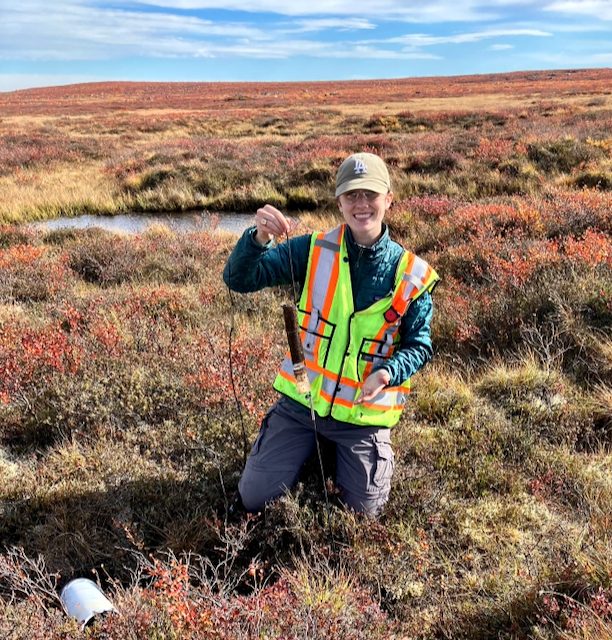
Petroleum resource exploration and development has occurred in the Northwest Territories since the 1920s. Freezing-point depressants, mainly potassium chloride, were added to drilling fluids to facilitate drilling into permafrost. Disposal of these fluids was typically in large man-made pits (sumps). Sumps were excavated in permafrost, with the intention that frozen ground would contain the fluids indefinitely. Climatic warming in northwest Canada has raised the temperature of near-surface permafrost, increasing the potential for failure of sumps in the region. Using electro-magnetic surveys, ground conductivity on and off sumps can be collected and analyzed to detect the presence of these fluids and determine if they have migrated.
By Tristan MacLean, ago
Long, clear icicles hang from a grassy, eroded embankment above dark soil, with patches of snow and frozen ground scattered across a cold, barren landscape under a partly cloudy sky.

Seminar – 8 May – The Effects of Environmental Controls on Epigenetic Ice-Wedge Cracking.

Gabriel Karam will be presenting The Effects of Environmental Controls on Epigenetic Ice-Wedge Cracking.

Date: 8 May 2024
Time: 13:00-14:00 Eastern Time
Location: Zoom (details are posted in our Teams site).

Ice-wedge polygons are a widespread periglacial feature in the continuous permafrost regions. To better understand the mechanical aspects of their formation, the extended finite-element method was employed to simulate the cracking process. Four case studies will be presented, which evaluate the effects different environmental controls and explore the growth of wedges over multiple years.

By Tristan MacLean, ago
A person stands and presents to an audience, pointing at a screen displaying a presentation titled Performance of Drilling Waste Sumps, Western Arctic Canada. Several people are seated facing the presenter.

Ottawa-Carleton Northern Research Symposium

The OCSNRS is an annual student academic conference focusing on Subarctic, Arctic and Antarctic research from natural & physical sciences, social sciences, humanities and applied sciences.

This year the University of Ottawa hosted the meeting which featured a number of permafrost presentations from the network:

  • Galina Jonat – A proposed Framework for Improved Simulations of Permafrost Change.
  • Frederic Brieger – Permafrost Terrain Disturbance Mapping and Susceptibility Modeling in the Na-Cho Nyäk Ge (Stewart River) Watershed, Yukon.
  • Rae Landriau – Performance of Drilling Waste Sumps – Mackenzie Delta NT.
  • Pia Blake – Effects of Snow and Surface Material on Surface Offset of Intermediate Slopes.

Read more about the symposium here:

Eng: https://www.uottawa.ca/en/events-all/ottawa-carleton-student-northern-research-symposium-ocsnrs

Fr: https://www.uottawa.ca/fr/tous-evenements/symposium-recherche-nordique-ottawa-carleton-sernoc

By Tristan MacLean, ago
Aerial view of a rural dirt road winding through a forested landscape with a large pond or wetland area on one side; two vehicles are driving along the road.

Seminar – 17 April – Climate change induced increases in maintenance costs for Yukon highways, 1994–2022.

Astrid Schetselaar will be presenting Climate change induced increases in maintenance costs for Yukon highways, 1994–2022.

Date: 17 April 2024
Time: 13:00-14:00 Eastern Time
Location: Zoom (details are posted in our Teams site).

Transportation networks in Canada’s North are becoming increasingly vulnerable to the impacts of climate change. Rising ground temperatures and permafrost thaw have been a cause of road damage as the bearing capacity of the ground is significantly reduced. Hydrological changes may further induce hazards, such as landslides, washouts, and icings (aufeis). Astrid’s presentation will outline a retrospective assessment of climate change-induced maintenance expenditures for highways in Yukon. Changes in costs are linked to climate, physiographic, conditions and underlying permafrost.

By Tristan MacLean, ago