A group of around 35 people, many involved in permafrost research, pose together in a conference room—some seated on the carpeted floor, most wearing name badges and smiling at the camera.

NSERC PermafrostNet connects a community

Stephan Gruber

NSERC Impact Story

Until recent decades, researchers could be confident that their studies about permafrost told the tale about this frozen phenomenon, which is known to underlie one-third of Canada. Permafrost is defined as ground that has remained at a temperature of zero degrees Celsius or less for two or more years. Climate change began to show its effects, and in doing so destabilized the certainties of a generation of research.

Worrying changes to the natural landscape makes new research even more imperative. For example, thawing in the north, where mining companies used to bury by-products from their operations, means that those pits are no longer seen as reliable containers. Relatively resistant to climate in the past, in 2016 the Dempster highway in the Yukon and Northwest Territories was cut in 14 places by landslides and washouts. Incidents like these signal the need not only for further studies, but also for enhanced information sharing with researchers across disciplines.

Enter NSERC PermafrostNet, a new research network based at Carleton University and involving researchers from 12 universities and over 40 partnering organizations including those in industry, Indigenous communities and government agencies nationally and internationally. PermafrostNet was one of only two Strategic Partnership Grants for Networks awarded in 2019 by the Natural Sciences and Engineering Research Council of Canada. Awarded $5.5 million, the new network aims to boost Canada’s ability to monitor, predict and adapt to large-scale permafrost thaw. Partners and participating institutions contribute an additional $0.6 million cash and $4.4 million in-kind support.

Steve Kokelj, Permafrost Scientist at the Northwest Territories Geological Survey, says “I view the Permafrost Network to be a potential game-changer for Canadian Permafrost Research. One aspect of the network is that it will foster collaboration across a diverse community of researchers and northern stakeholders. The network can create an environment where universities, government and northern organizations work together to develop the knowledge and capacity to overcome the growing permafrost related challenges faced by northerners now and into the coming decades.”

Stephan Gruber, Canada Research Chair in Climate Change Impacts/Adaptation in Northern Canada is a principal investigator for NSERC PermafrostNet. He says that the idea for a network gained momentum at a workshop in 2017, where 60 people from different levels of government and academia across Canada gathered to assess what was needed to move forward with research and improved practice in this area.

The network has since gained support from organizations across Canada. Carolyn Relf, Director of the Yukon Geological Survey, says that “Yukon is keen to support and participate in the network’s work, as climate change adaptation is a priority for Yukon government. Permafrost degradation is impacting communities and infrastructure across the territory, and the opportunity to collaborate in this research will enhance Yukon’s capacity to map permafrost and identify susceptible areas.”

Part of the network’s mandate will be to train 24 doctoral students, 17 master’s students, four postdoctoral fellows and 16 northern research assistants, fostering the next generation of scholars, practitioners and policy makers. Today, the network involves researchers from the University of Alberta, University of Calgary, Laurentian University, Université de Montréal, University of Ottawa, Queen’s University, the Royal Military College of Canada, Simon Fraser University, University of Waterloo and the University of Victoria. Involved organizations include the Canada Nunavut Geoscience Office, Fort Severn First Nation to the Geological Survey of Canada and the Yukon government to name just a few of the 40.
Read the original story on the NSERC website.

By Tristan MacLean, ago
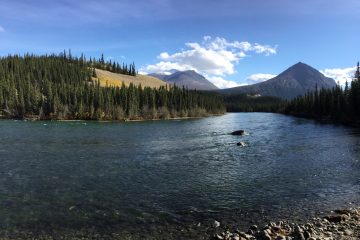
A clear river flows past a rocky shore, surrounded by dense evergreen forests with mountains rising in the background under a bright blue sky with scattered clouds.

Our new sustainable and environmentally friendly Canadian-based website

The NSERC PermafrostNet website is now powered by renewable energy, generated here in Canada, thanks to Web Hosting Canada (WHC).

Here at NSERC PermafrostNet we want to ensure that our values and ethos are applied to all aspects of our work and so we decided one of the best places to start was with our own website. Websites are hosted on servers in data centres that require considerable amounts of electricity to operate and need constant cooling to prevent overheating. In most places, this electricity is produced from fossil fuels that contribute to climate change. What we wanted to do was ensure our website was stored on Canadian servers and powered by sustainable and environmentally friendly energy. WHC data centres are powered by hydroelectric energy and the servers are temperature-controlled by outside air and water cooling technology rather than air conditioning. Furthermore, all the data is stored on Solid State Drives, which use a fraction of the power needed by traditional mechanical storage. By switching to WHC we have ensured that our data is safely secured in Canada and that we are supporting Canadian business and infrastructure, while minimizing our impact on the environment.

Green Hosting Badge

By Tristan MacLean, ago
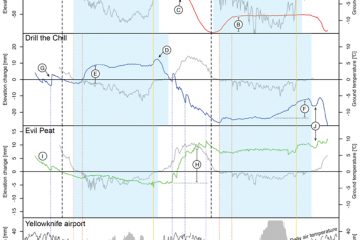
Four line graphs show snow height, elevation change, ground temperature, and air temperature from 2016 to 2019 at three sites (Active Slayer, Drill the Chill, Evil Peat) and Yellowknife airport. Key events are marked with vertical lines.

New publication: Ground subsidence and heave over permafrost.

Ground subsidence and heave over permafrost: hourly time series reveal interannual, seasonal and shorter-term movement caused by freezing, thawing and water movement.

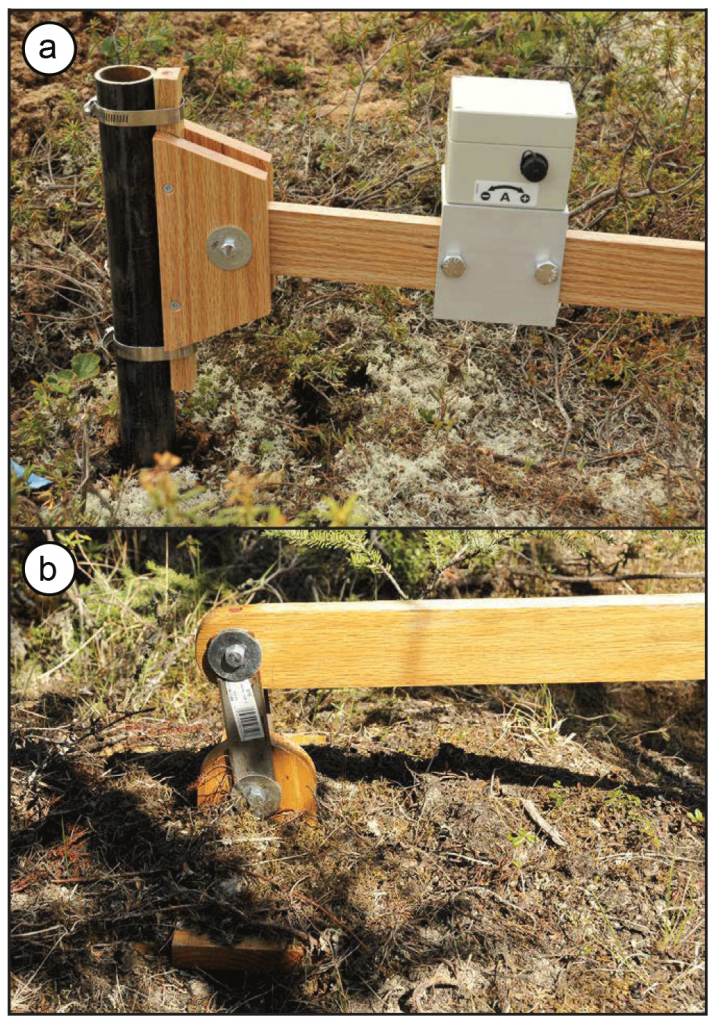
Image showing two close-up views of scientific equipment outdoors: (a) a wooden arm with a white box and a black tube, and (b) the arm’s joint mechanism anchored in the soil among grass and plants.

Heave and subsidence of the ground surface can offer insight into processes of heat and mass transfer in freezing and thawing soils. Additionally, subsidence is an important metric for monitoring and understanding the transformation of permafrost landscapes under climate change. Corresponding ground observations, however, are sparse and episodic. A simple tilt-arm apparatus with logging inclinometer has been developed to measure heave and subsidence of the ground surface with hourly resolution and millimeter accuracy. This contribution reports data from the first two winters and the first full summer, measured at three sites with contrasting organic and frost-susceptible soils in warm permafrost. The patterns of surface movement differ significantly between sites and from a prediction based on the Stefan equation and observed ground temperature. The data are rich in features of heave and subsidence that are several days to several weeks long and that may help elucidate processes in the ground. For example, late-winter heave followed by thawing and subsidence, as reported in earlier literature and hypothesized to be caused by infiltration and refreezing of water into permeable frozen ground, has been detected. An early-winter peak in heave, followed by brief subsidence, is discernible in a previous publication but so far has not been interpreted. An effect of precipitation on changes in surface elevation can be inferred with confidence. These results highlight the potential of ground-based observation of subsidence and heave as an enabler of progress in process understanding, modeling and interpretation of remotely sensed data.

Gruber, S.: Ground subsidence and heave over permafrost: hourly time series reveal interannual, seasonal and shorter-term movement caused by freezing, thawing and water movement. The Cryosphere, 14, 1437–1447, https://doi.org/10.5194/tc-14-1437-2020, 2020.

By Tristan MacLean, ago
A close-up illustration of several coronavirus particles, shown as dark spheres with red spike proteins, floating against a dark green background.

COVID-19: NSERC PermafrostNet response and resources

In response to the COVID-19 outbreak, NSERC PermafrostNet is ensuring operational continuity and support for our staff, volunteers, researchers, and trainees. This complements the directives of individual organizations and public health officials. Key actions being undertaken are listed below. 

  • NSERC PermafrostNet’s offices are closed and staff are working from home. 
  • In addition to email, our team can still be reached by phone, Microsoft Teams or Zoom. General inquiries should be sent to permafrostnet@carleton.ca
  • PermafrostNet-funded travel has been indefinitely postponed. 
  • The safety of all of our members, and especially our northern partners and their communities is a priority. NSERC PermafrostNet will be consulting with partners and the wider community so that we respect their decisions and concerns about health and safety.
  • NSERC PermafrostNet has cancelled field plans for summer 2020. We will begin reconsidering field work only once it is acceptable to partners and communities in those locations.
  • The network will move planned events online where possible, for example the two-day permafrost data workshop in the last week of May.
  • The Field Work Training Exercise that had been planned for May 2020 has been postponed to 2021.

Please follow us on TwitterLinkedIn or by signing up to our newsletter for the latest updates.

By Tristan MacLean, ago
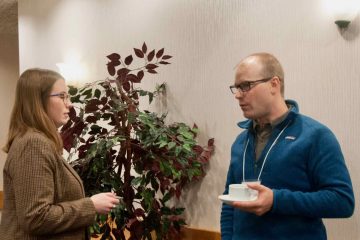
Two people are standing indoors near a potted plant, engaged in conversation. One is holding a saucer and cup, while both wear glasses and conference lanyards. The setting appears to be a conference or meeting area.

New team member – Emma Stockton

Emma Stockton

The network has taken on Emma Stockton as a part time administrative assistant to help the Director of Operations. Emma is a Ph.D. candidate working with Chris Burn on Permafrost and infrastructure sustainability, western Arctic Canada. Emma is examining various aspects of the ground thermal regime along the Dempster Highway and Inuvik-Tuktoyaktuk Highway, including a comparison on conditions beneath and beside the road, the effect of soil moisture on ground temperatures, and the role of snow accumulation at the sides of the embankment. Her PhD work is supported by the NWT Geoscience Office and Transport Canada.

By Tristan MacLean, ago
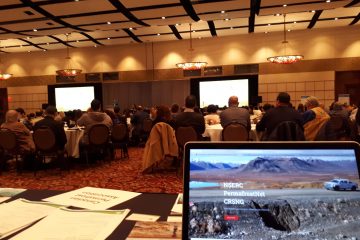
A conference room filled with people seated at round tables, facing a stage with large screens. In the foreground, a laptop displays a website about NSERC PermafrostNet. Papers are spread on the table next to the laptop.

Land Claims Agreement Coalition Conference 2020

“Until this conference I wasn’t aware of the extent of Modern Treaties Territories, but I know that permafrost is distributed across much of northern Canada. The conference made me realize that these Territories almost completely overlap the permafrost zones in Canada. Several northern communities are severely impacted by climate change and thawing permafrost, but it really hits home that most of the future permafrost changes will occur within Modern Treaties Territories.”

Peter Morse, CPA Secretary and NSERC PermafrostNet collaborator
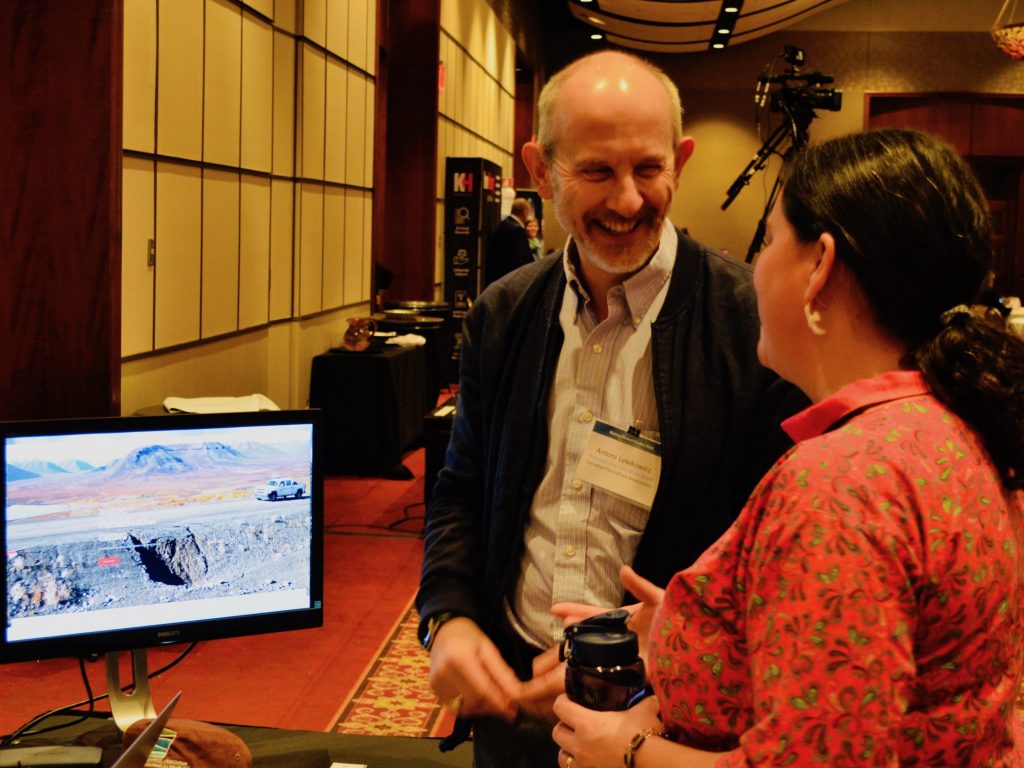
Two people stand by a computer monitor displaying a desert landscape at an indoor event. The man is smiling and wearing a name tag, while the woman holds a cup and faces him, engaging in conversation.

On 11 and 12 February 2020, the Land Claims Agreement Coalition held their 8th National Conference, Making Modern Treaties Work: Building Today for a Better Tomorrow in Gatineau, QC.

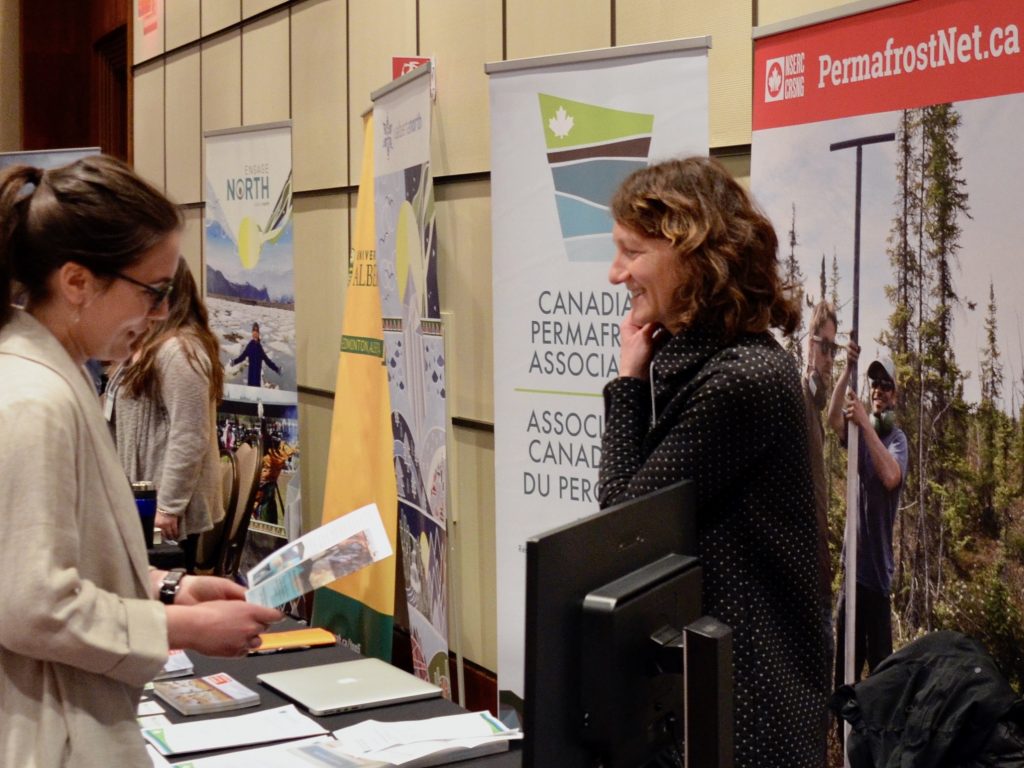
Two women speak at a booth with brochures and banners about permafrost studies, including one for the Canadian Permafrost Association. A large photo banner behind them shows research in a forested area.

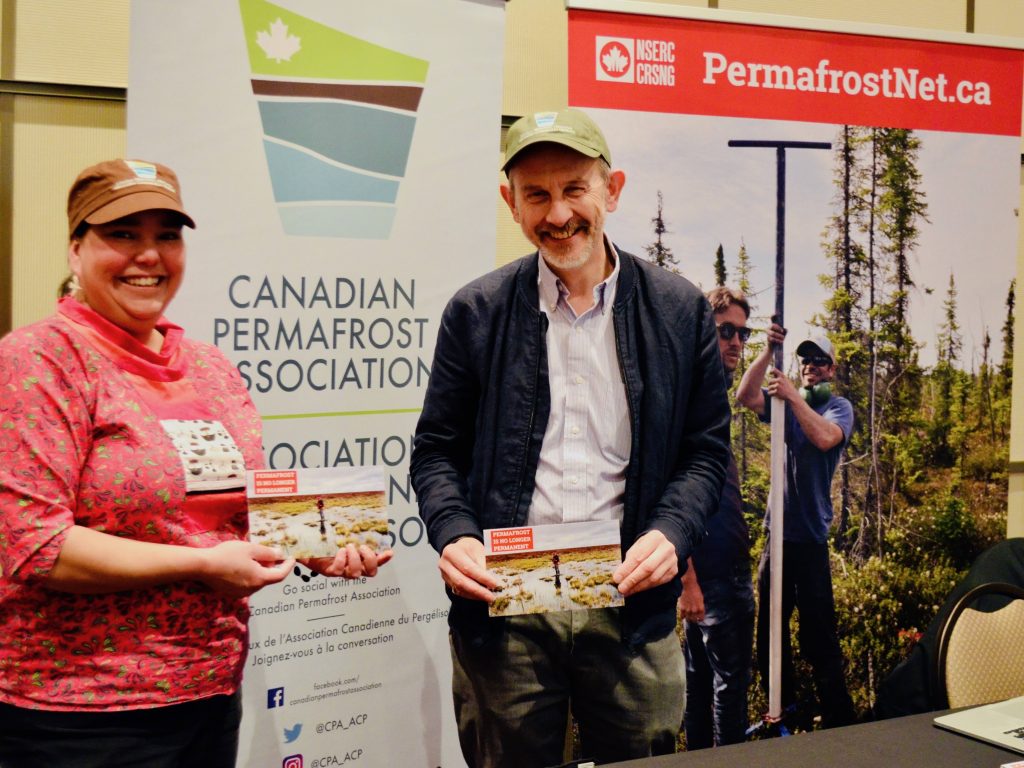
NSERC PermafrostNet and the Canadian Permafrost Association came together to share a booth at the conference. The event provided a great opportunity to introduce our two organizations, explain what we do and hear about the climate-change related challenges faced by Indigenous communities.

Two people smile at a booth with Canadian Permafrost Association and PermafrostNet.ca banners, holding brochures. Another banner shows two people in the field taking permafrost measurements.

The conference featured high-profile Canadian and international speakers, First Nation and Inuit leaders and youth, leading to meaningful discussions of timely legal, cultural and governance issues. The sessions focused on academic and technical training and improving intergovernmental relationships. Esteemed and inspiring speakers, included: Dana Tizya-Tramm, Chief, Vuntut Gwitchin First Nation, Daniel Watson, Deputy Minister of CIRNAC, P.J. Akeeagok, President of the Qikiqtani Inuit Association and Gregor Gilbert, Director, Department of Environment, Wildlife, and Research at Makivik Corporation.

Photos: Tristan MacLean

By Tristan MacLean, ago
A snowy, frozen landscape with mountains in the background, illuminated by green aurora borealis lights in the night sky, reflecting on icy water in the foreground.

Third Canadian Polar Data Workshop

The workshop was the ideal venue to introduce PermafrostNet to the polar data management community and to learn from other communities of practice to ensure that the network will help permafrost data fit into the broader ecosystem of interoperability.”

Nick Brown
A reserved table set for a meal at a bright, windowed venue with a sign reading Third Canadian Polar Data Workshop. Snowy mountains and people are visible through large windows in the background.

The Third Canadian Polar Data Workshop was held 18-21 February 2020 in Banff, Alberta. The event is organized by the Canadian Consortium for Arctic Data Interoperability (CCADI), who aim to advance collaboration, through development of an integrated Canadian arctic data management system and Arctic Research Data Infrastructure (ARDI). The purpose of the third Canadian Polar Data Workshop is to gather people involved in polar data management from across Canada to share ideas and identify key priorities and commitments for coordinating the work of the polar data community and, ultimately, advancing our work.

A group of people are seated at round tables in a conference room, listening to a presenter speaking next to a projected presentation slide. Laptops, notebooks, and coffee cups are on the tables.

The workshop provided an opportunity for members of the Permafrost Network to discuss issues of data sharing architectures and data governance with research communities who are facing similar challenges. In attendance from NSERC PermafrostNet were scientific director Stephan Gruber, scientific committee member Peter Pulsifer, network data scientist Nick Brown as well as two members from the broader PermafrostNet community: Ashley Rudy (Northwest Territories Geological Survey) and Etienne Godin (Laval University).

A scientific research poster about NSERC PermafrostNet is displayed on a wall next to a framed abstract black and white artwork resembling a large nail or stake. Both hang above a light-colored wooden ledge.

Held at the Banff Centre, the workshop began with presentations from some of the attending organizations including PolarView, CCADI and Inuit Tapiriit Kanatami. There were presentations by network member Peter Pulsifer and a poster by the PermafrostNet data scientist Nick Brown on advancing interoperable and open permafrost data on day two. The agenda then turned to a more interactive format identifying the needs of the community for improved formal vocabularies and semantics, and visioning the formation of a committee to help coordinate polar data management. The event concluded with a hackathon focused on implementing code to make datasets more discoverable online. A relatively strong turnout by the permafrost community made for great conversations between formal sessions, and will help PermafrostNet make data interoperable with other initiatives.

Photos: Nick Brown

Third Canadian Polar Data Workshop Poster
By Tristan MacLean, ago
Raven interview with Nick Brown

Unfrozen: How digging and data can help mitigate permafrost thaw

“Highways buckle and heave, houses sink, and pipelines and other linear infrastructure are particularly susceptible.”

Nick Brown, NSERC PermfrostNet Data Scientist
A climber wearing a helmet and safety gear ascends a steep, rocky mountain face using ropes, with snow and ice visible in the background.

Nick Brown was recently interviewed for the first edition of the new Carleton University magazine – Raven.

“PermafrostNet’s data scientist, Nick Brown, who met Gruber while running a fly-in geological services field camp on the tundra east of Yellowknife and later did his master’s degree with Gruber, explains how the new network will address one of climate change’s biggest challenges.”

Raven interview with Nick Brown

You can read the full interview on page 44 of the new Carleton University magazine Raven.

Raven magazine is published by Carleton University’s Department of University Communications, with support from the Office of the President and the Office of the Provost. Raven is a showcase for the important and impactful work of Carleton faculty, students, staff, alumni and the university’s community partners.

Photo: Stephan Gruber

By Tristan MacLean, ago
Northern Lights 2020

Northern Lights 2020

Members of NSERC PermafrostNet were honoured to attend the 2020 Northern Lights Showcase at the Shaw Centre in Ottawa between 5 – 8 February. The event is Canada’s number 1 Eastern Arctic and Northern conference, featuring presentations, an exhibitor showcase, workshops and a variety of networking opportunities. The first Northern Lights event was in 2008 and now happens every two years, focusing on the socio-economic and cultural development of Nunavut, Nunavik and Labrador / Nunatsiavut.

Northern Lights 2020

“The quality and engagement of the speakers and panelists at the workshops I attended were very high.  The presenters were all sincere, approachable and knowledgeable, and I learned a great deal about the North and Northern engagement”

Shirley McKey, NSERC PermafrostNet Director of Operations
Shirley McKey at Northern Lights 2020

PermafrostNet had a booth on the show floor, where we were able to speak to delegates and members of the public; explaining who we are and what we do. We had a lot of interest from visitors to the show, wanting to know all about permafrost and sharing their experiences of living with permafrost in a changing world. The showcase was a fantastic opportunity to engage and hear from Canadian businesses, community leaders and indigenous government about permafrost and life in the North. The event was attended by Scientific Director (Stephan Gruber), Director of Operations (Shirley McKey) and Knowledge Mobilization and Communications Coordinator (Tristan MacLean).

The conference sessions covered a wide range of areas impacted by permafrost change, such as infrastructure, housing, construction, transport and communication as well as areas where collaboration will help the network share knowledge and serve northern communities such as education and communications. Of particular interest to the network were the sessions ‘Northern Infrastructure: Building for the Future‘ and ‘Arctic Research & Education: Supporting Sustainable Northern Communities‘ as well as the opportunity to make connections and build relationships with many residents and organizations based in the North whose lives and livelihoods are being directly impacted by permafrost thaw.

Shirley McKey engaging delegates at Northern Lights 2020

Photos: Tristan MacLean

By Tristan MacLean, ago
Theme 1 workshop

Theme 1 and Database Development Workshop

“It was very convenient to be able to connect to the workshop remotely so that I could get an update on other people’s work and so I could give an update on my research as well. I like how the network ensures everybody can attend important meetings while also helping to lower our carbon footprint.”

Ariane Castagner
A man gestures while explaining geological diagrams displayed on a large screen, which show cross-sections of soil layers and labeled data, in a classroom or meeting room setting.

In February 2020 Theme 1 organized a two-day database development meeting in Ottawa that brought together investigators, graduate students, government collaborators and the network data scientist. This was the network’s first hybrid event, with some participants joining virtually using ZOOM, a video conferencing platform. 

Theme 1 workshop

The event began on Thursday 6 February with a discussion about the existing ground ice maps for Canada.  Brendan O’Neill and Steve Wolfe presented the most recent GSC ground ice map (O’Neill et al. 2020), and the group discussed the possible areas for improvement and future. In the afternoon, students Joe Young, Alejandro Alvarez and Ariane Castagner presented on their research.

Four men are seated at a conference table having a discussion, while another man stands by the wall near a screen displaying the SARlab logo and presentation. Laptops, papers, and coffee cups are on the table.

On Friday, Steve Kokelj introduced the NWT Thermokarst Mapping Initiative and discussed possibilities for evaluating the Ground Ice Distribution and thermokarst potential. Next, the group reviewed regional datasets that could be used to test or improve ground ice mapping; Peter Morse, Ariane Castagner, Ashley Rudy, Panya Lipovsky, Pascale Roy Léveillée, Daniel Fortier and Toni Lewkowicz each presented datasets from their study sites or area of expertise. These datasets ranged in geography from the Yukon to the Hudson Bay Lowlands to the polar deserts of the high arctic.

This was followed by a discussion of some of the key questions for the PermafrostNet Ground Ice Potential map: whether test sites should be used for evaluation (and how such and evaluation might be done!) and how the maps might move past rule-based strategies to include remotely sensed or hybrid models.

Finally, Nick Brown presented on the existing database structures that could be used for compiling diverse permafrost data for the network, and initiated discussion about how to improve the database to meet the needs of the network. This also included a discussion of how ground ice mapping efforts could benefit from the PermafrostNet partnership with CCADI. 

Photos: Nick Brown and Emma Stockton

By Tristan MacLean, ago