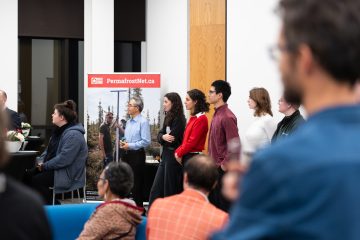
On the 18th of November 2025, NSERC PermafrostNet concluded its transformative six-year journey with a celebration at Carleton University’s Advanced Research and Innovation in Smart Environments (ARISE) Building in Ottawa, bringing together researchers, community members, partners and supporting organizations.
The finale marked a significant moment in Canadian research with the end of the first strategic national partnership to address thawing permafrost.
The evening began with welcomes and introductions from Elham Gharji, the NSERC CREATE LEAP Program Coordinator, followed by presentations from Janet King (PermafrostNet Board Chair), Rafik Goubran (VP Research & International at Carleton University), and Tristan MacLean (Director of Operations), who shared perspectives on the network’s accomplishments, institutional support, and quantified impact.
PermafrostNet’s strength lay in its collaborative structure, with 16 professors, 45 graduate students and post-doctoral fellows, 40+ partner organizations, and 200+ active network members spanning government, Indigenous communities, and industry.
The evening highlighted extraordinary achievements across multiple dimensions. The network trained over 60 people, many of whom now conduct permafrost research within government, academia, or industry. Scientific outputs include over 70 publications, 100+ conference presentations, and the development of critical data products. This included compiling geotechnical records representing approximately 60,000 measurements, and generating new ground ice estimates from these data using the Canadian Permafrost Index Properties (C-PIP database). The network’s climate modeling work enhanced the CLASSIC system to incorporate carbon cycling in permafrost-affected soils, implement a feather moss plant functional type, parametize plant hydraulics, and assessed the biogeochemical cycles of soil nutrients following wildfires in permafrost terrain.
In addition to the scientific accomplishments, the finale reception was an opportunity to recognize the capabilities developed, the relationships established, and new initiatives the network has catalysed.
After an intermission featuring networking and refreshments, the evening continued with Ramona Pearson providing an inspiring talk about Scotty Creek Research Station, followed by Olivia Meier-Legault reflecting on the student experience and training legacy, and Stephan Gruber, the Scientific Director, concluding the evening with remarks on the network’s vision and future directions.
As the network concludes, its legacy persists through continued initiatives like CREATE LEAP, PermaRail and through the next generation of permafrost researchers shaped by this collaborative vision. The finale marks not an ending, but a transition. The knowledge, relationships, and capabilities built through NSERC PermafrostNet will continue to serve Canada’s North, inform climate adaptation strategies, and inspire the next generation of permafrost researchers.